
Fractional forward deployed engineer · Nearshore
The forward deployed engineer you can’t justify hiring full-time.
I map one of your processes the way it actually runs, not the way the SOP says it does, re-engineer it with AI agents inside the systems you already use, and prove the result against a baseline measured before anything gets built.
The same method the large FDE teams use, by the process instead of by the headcount, from Mexico City, during your working hours.
I direct the work; the build is done by Neuman Solutions, my agency. Either way, the number is mine to answer for.
Companies I have worked with




Why most AI pilots never reach production
Applying AI to a broken process just makes the mess move faster.
Michael Hammer made the case in Harvard Business Review in 1990: companies were spending heavily on IT and getting little back, because they automated old processes instead of redesigning them. AI is repeating the pattern. This is what shows up when almost any process gets opened:
You were told it takes 6 steps. It takes 14.
The SOP describes the happy path. The loops — the invoice that bounces back, the approval that gets re-requested, the quote that goes back to deal desk — are written down nowhere, and that is where the time goes.
The real process lives in one person’s head.
Someone who has been in the role for years knows which vendor always sends the wrong PO and which customer always pays late. There is no document to point an agent at. That knowledge has to be interviewed out.
The waiting is the process. The work is minutes.
Hammer documented an insurance application that took 22 days to move through the company and held 17 minutes of actual work. Make every step twice as fast and you save 8 minutes. What gets re-engineered is the queues and the handoffs, not the tasks.
Composite example · not a client
Collections at a distributor: the SOP says 6 steps, the system says 14.
The red steps are in no SOP: fixing billing details, chasing the PO number, waiting on remittance details. Nobody counts them, and that is where the weeks go.
What the SOP says · 6
- 1Send invoice
- 2Send statement
- 3Send reminder
- 4Receive payment
- 5Apply cash
- 6Reconcile
What the system log shows · 14
- 1Send invoice
- 2Fix billing details
- 3Reissue invoice
- 4Send statement
- 5Chase the PO number
- 6Send reminder
- 7Call the customer
- 8Wait for a reply
- 9Receive payment
- 10Match the remittance
- 11Apply cash
- 12Chase remittance details
- 13Wait for details
- 14Reconcile
- In the SOP
- Not in the SOP
- A step done again
- A loop back
How I work
Process first, agents second.
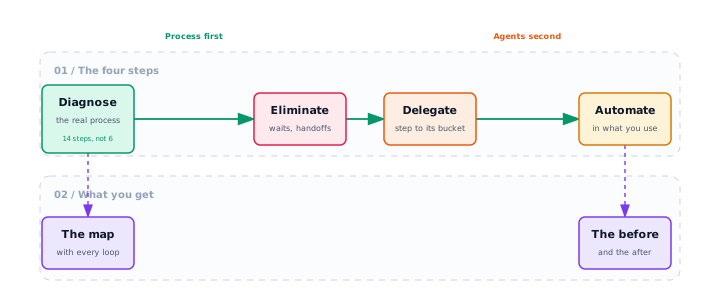
The work is rarely what takes long. The wait between one person and the next is, along with the message nobody answers and the data someone types in twice. So nothing gets installed first. The order is always the same: diagnose, eliminate, delegate and, last, automate.
See how the work actually runs
The trail your CRM or ERP leaves for the what (dates, changes, who touched what) and the people who do the work every day for the why. The SOP says how it should run; they know where it gets stuck. And at every step, how long the work waits against how long someone actually works on it.
You get a map of how the work actually runs, with every loop and what each one costs.
Remove the waits and handoffs
Before automating anything, the flow gets redesigned: which steps go away, which notice can arrive on its own, which re-keying disappears if the data comes in right at the source. One version of the process, with someone who can sign it off across every department it touches. Part of this is not AI at all.
You get the process without the dead weight, and with an owner.
Put every step where it belongs
Fixed rules go into plain code: cheap, auditable, and it does not get things wrong. Steps that need judgment and have history go to an agent. Anything expensive to get wrong is decided by a human, with the evidence already laid out in front of them.
You get every step in its bucket, drawn out before a line of code is written.
Baseline, validate, then build
Cycle time and cost per transaction get measured today, so the result is compared against your numbers and not a promise. A small demo comes before the full system, starting with the flow that has the most handoffs, which is not always the one with the most volume. Agents run inside your Salesforce, HubSpot, NetSuite, inbox or Slack.
You get the process running in production, and a before and after you can take to whoever signs the budget.
The step most teams skip
Not everything needs AI. Every step lands in one of four buckets.
The same 14 collection steps. Four are deleted, not automated. Rules handle what needs no judgment, agents prepare the work, and a person negotiates and signs off.
Delete · 4
Should not exist
- 3Reissue invoice
- 5Chase the PO number
- 8Wait for a reply
- 13Wait for details
Plain code · 5
Rules, no judgment
- 1Send invoice
- 2Fix billing details
- 4Send statement
- 6Send reminder
- 9Receive payment
Agent · 3
Judgment with history
- 10Match the remittance
- 11Apply cash
- 12Chase remittance details
Human · 2
Negotiates and signs
- 7Call the customer
- 14Reconcile
The same process, by owner
The waiting disappears. The decisions stay with a person.
Before, the case moves hand to hand and twice sits waiting on the customer. After, rules and agents carry the back and forth, and the AR team and accounting only see what needs judgment.
Before · 14 steps · 2 waits · 2 loops
| Invoice | Collect | Receive payment | Close | |
|---|---|---|---|---|
| Customer | 8 · Wait for a reply | 13 · Wait for details | ||
| AR team | 2 · Fix billing details | 4 · Send statement5 · Chase the PO number6 · Send reminder7 · Call the customer | 12 · Chase remittance details | |
| Accounting | 1 · Send invoice3 · Reissue invoice | 9 · Receive payment10 · Match the remittance11 · Apply cash | 14 · Reconcile |
After · 10 steps · no waits · 2 human decisions
| Invoice | Collect | Receive payment | Close | |
|---|---|---|---|---|
| Customer | ||||
| Rules and agents | Validate billing detailsSend invoice | StatementReminders | Payment arrives on a bank feedAgent: matches the remittanceAgent: applies cashAgent: requests missing details | |
| AR team | Call only who needs it | |||
| Accounting | Sign off the reconciliation |
Recognize your own process in this map?
Book a callThe comparison that matters
Three ways to get a forward deployed engineer into your operation.
Hire a full-time FDE
Months of search, and a salary priced for the AI market.
Few people inside can evaluate the candidate, and a mid-size company rarely has enough processes queued to keep one busy all year.
Bring in a consultancy
A discovery engagement, then a separate statement of work to build.
The people who map it are not the people who build it, and the deck describes the process the SOP says you have, not the one you run.
Fractional, nearshore FDE
Quoted per process after a short call. Month to month after that.
The person who maps it directs the build and owns the number. Based in Mexico City, working hours that overlap yours, calls and documentation in English.
What gets measured depends on who signs
Every department counts its money differently.
The baseline is chosen with whoever owns the budget, in their numbers. These are the ones that move most when a process is re-engineered well:
CFO
Days to close the books, cost per invoice processed, and how many invoices go straight through without anyone touching them.
CRO
Hours from inbound lead to first response, quote cycle time, and how many deals loop back through approval.
COO and People
Time to hire, time to productivity for a new hire, and how often the same request gets redone.
I ran it on my own business first
PostLeads: what the map found before anything was built.
PostLeads pulls the people who reacted to and commented on a LinkedIn post, with their work email. To build it, I mapped my own post-to-sale process, and the map turned up three things no SOP mentioned:
A LinkedIn post with 157 reactions returned 100. The source pages results a hundred at a time and nothing was asking for page two, so 57 people never showed up anywhere.
In a single post with 279 people. Someone who reacts and comments arrives with two different profile URLs; without merging them, their email gets looked up, and billed, twice.
Measuring before building more showed the bottleneck was the source material of the posts, not the tone. Building on top of it stopped until that was fixed.
Why the job pays, and why few people do all of it
This work takes three people in one.
A consultancy understands the process but does not build. A software firm builds but does not know what to trust a model with. An AI lab knows models but has never sat down with finance. You need all three at once.
Understands how the work actually runs
Finance, sales, operations. Knows which step is theater and who really decides. Consultancies have this person.
Processes mapped and re-engineered with clients, published with the problem and the result.
Ships production software into your systems
Software that reads and writes in your CRM, your ERP and your inbox, with permissions and a way to roll back. Software firms have this person.
20+ years building software.
Knows what a model can be trusted with
Evals for every step, several models with no lock-in, and guardrails that check what a model produces before it ships. AI labs have this person.
Agents in production, including Hermes and the PostLeads engine.
How an engagement starts
Start with one process, not the whole company.
And not the one with the most volume: the one with the most handoffs, which is where the most time is lost and where the result shows first.
- Step 1
Discovery call
No cost
We pick the process that is costing you the most and decide whether it is worth re-engineering.
You get
Which process to start with, and what to measure before building.
- Step 2
Map, re-engineer and build
Quoted per process
The real process mapped, the new one sorted step by step, and the agents running inside your systems.
You get
Agents in production, and a measured baseline to compare against.
- Step 3
Measure and operate
Month to month
Every month the result is compared against the baseline, drift gets fixed and the agents are kept running.
You get
A before-and-after report, and the next process if it pays off.
Before you book
This is a fit for a few companies, on purpose.
- There is a process that repeats every week and someone does it by hand
- You know, or suspect, what it costs you
- Someone owns that process and can give me an hour a week
- You would rather start with one process and measure it before the next
- You want AI rolled out across the whole company this quarter
- Nobody inside owns the process
- Step one is migrating to a new CRM or ERP
- You expect an agent to pay or sign without a human reviewing it
What I build with
The technical side, for whoever wants to check it.
It sits at the bottom on purpose: it is the how, not the what. The tools are chosen for the process, not the other way around.
Questions
What does a forward deployed engineer actually do?
Works inside your operation instead of handing you a tool: maps the process as it really runs, re-engineers it, builds the agents inside your systems, and measures the result. The difference from a consultancy is that the person who maps it stays on through the build, directs it, and is accountable for the number.
Why not just hire one full-time?
If you have a queue of processes that keeps an engineer busy all year and someone who can evaluate the hire, you should. Most mid-size companies have a handful of processes worth re-engineering, not a year of them, and a fractional engagement lets you prove the first one before you commit to a headcount.
Do we have to switch systems?
No. Everything is built inside the systems you already run. A CRM or ERP migration takes years and serious budget; an AI proposal that starts there rarely reaches production.
How does working with someone in Mexico City work?
Mexico City working hours overlap the US business day, so calls happen during your day, not at midnight. Calls, documentation and deliverables are in English.
Which models do you use?
Whichever one passes the test for that step. Every agentic step is benchmarked against several models before choosing, and the most expensive one is rarely needed. And no lock-in to a single provider: when one raises prices or retires a model, it gets swapped and the tests get rerun. Many steps do not need AI at all: they are plain code.
Is this about cutting headcount?
The goal is to stop your most experienced people from keying, reconciling and chasing paperwork by hand. What you do with that time is your call, and it is usually moving them to work that actually needs judgment.
Who does the building, you or a team?
I direct: I map the process, decide what gets automated and in what order, and define how it is measured. The implementation is done by Neuman Solutions, my agency, and I stay accountable for the number either way. If what you want is your own team learning to build it, that is a different engagement.
One short call to find the process that is costing you the most.
You walk me through how it runs today, we look at where the time goes, and you leave with the process to start with and what to measure before touching it, whether we work together or not.
Quoted per process · the proposal comes out of the call